

Vaults of the church significant to Lithuanian and Polish history have been restored
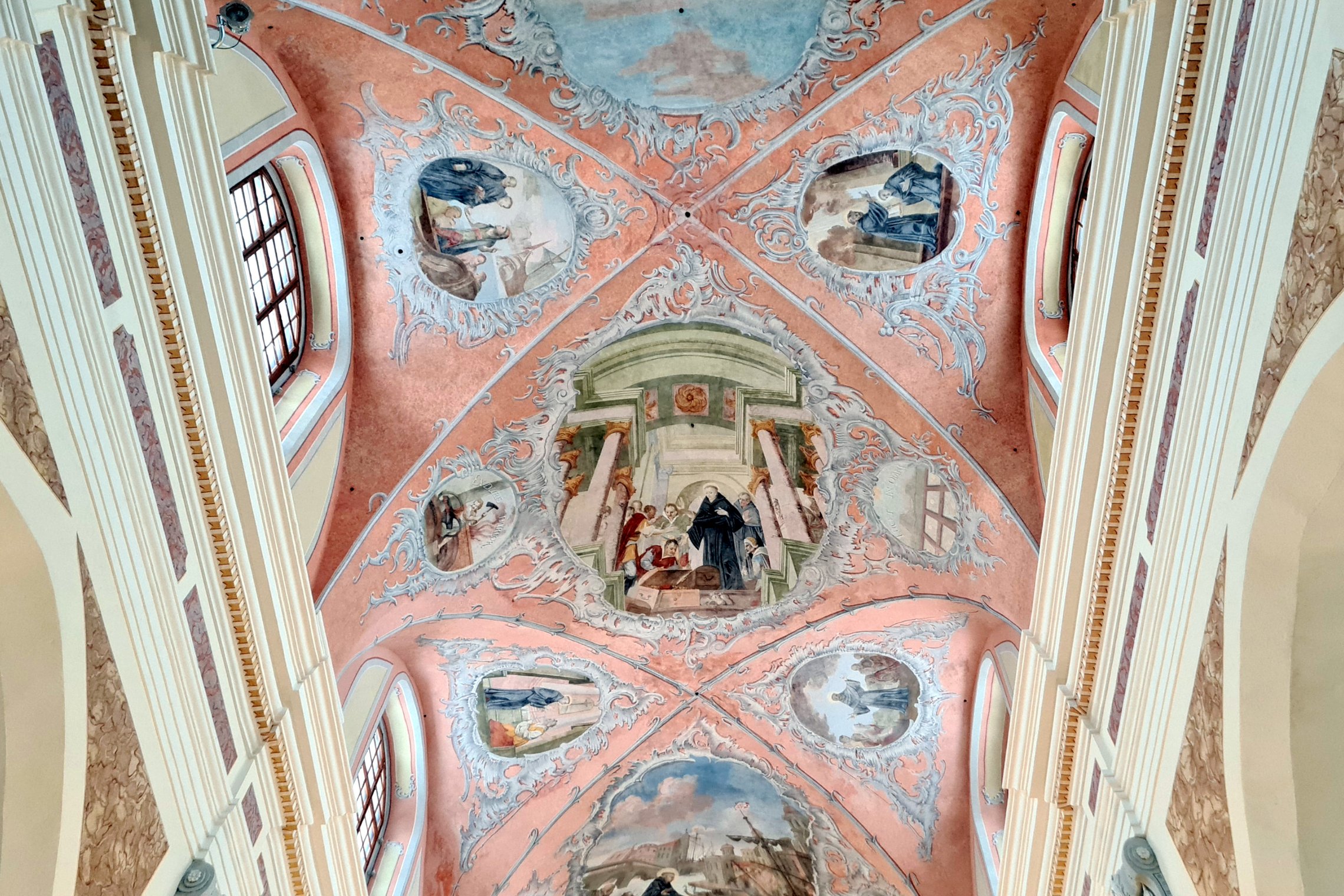
On the 10th of January, at the Church of Our Lady of the Assumption in Vilnius (often referred to by the locals as the Franciscan Church of Vilnius, located at 9 Trakų Street), nearly a decade-long restoration and conservation work of the vault paintings was presented. The vaults of the main nave revealed mural paintings of exceptional value – as many as 22 scenes depicting the story of the life of Saint Anthony of Padua through images. This is the largest cycle of mural paintings depicting the life of Saint Anthony of Padua in Lithuania painted at the end of the 18th century by the Marian monk Francis Nemirovsky and an unknown Uniate clergyman. In Lithuania, this example of the veneration of the saint of late Baroque of the Grand Duchy of Lithuania has no analogues; the closest work to it is the mural painting in the Bernardine Church in Warsaw.
The event was attended by Vidmantas Bezaras, Director of the Department of Cultural Heritage, Dorota Janiszewska Jakubiak, Director of the Polish National Institute for Cultural Heritage Abroad ‘Polonika’, Polish Ambassador to Lithuania Konstanty Radziwill, the restorers who carried out the preservation and conservation works, and dignitaries of the Church and the Franciscan Order. The conservation and restoration of the mural paintings of the Church of Our Lady of the Assumption in Vilnius was carried out by several Lithuanian restoration teams, with the funding from the Polish government under the ‘Protection of Cultural Heritage Abroad’ programme.
The Church and the Monastery in the vortices of history
The Church of Our Lady of the Assumption in Vilnius was started to be built right after the baptism of Lithuania in 1387. Three years later, during the siege of Vilnius, the Church was destroyed by the Crusaders and their allies, rebuilt at the end of the 14th century, and consecrated at the beginning of the 15th century. According to historians, the size of the Church, chosen in the 15th century, corresponded quite closely to that of today. The red brick masonry with a burnt brick cross, uncovered by the restorers, dates back to the 15th and 16th centuries, and the round tower and the staircase were also built during that period. Like the whole of Vilnius, the Church and the Franciscan Monastery in Vilnius have been devastated many times by the elements, looting and wars. The Church and the Monastery suffered most severely in the 18th century, during the plague and famine of the Great Northern War in the first decades of the century, followed by the great fires of 1737, 1748 and 1749. However, thanks to generous patrons and an active Franciscan community, the losses were rebuilt fairly quickly, adapting to the architectural fashions and tastes of the time - at the end of the eighteenth century, the buildings were completely rebuilt, and in 1794 the Church was consecrated anew, already as a part of the complex, which had already taken on the baroque appearance. It was during this period that the vaults of the Church were decorated with mural paintings, the second organ was installed, the main and side altars were repaired, the largest part of the floor was laid with marble slabs, the liturgical utensils were renewed and the pulpit was renovated.
The complex of sacral buildings also suffered greatly during the war of 1812, and finally was closed completely in 1864 by the Tsar of Russia. At that time the Church was made into an archive, and during the reconstruction and remodelling of the building, the entire vaulting was covered with a layer of white lime paint. It was not until 1932, when the layer of paint that covered the painting began to crumble, that Vilnius society became aware of the overpainted painting. After the Second World War, during the decades of the Soviet occupation, the Church was again converted into an archive. During this period, the painted vaults continued to deteriorate, and in many places, they were in poor condition: the plaster had detached from the moisture and crumbled onto the ground, and the paintings were affected by mould. Despite the fact that in 1971 the painting of the vault of the Franciscan Church in Vilnius was included in the list monuments of local importance, the architectural complex began to be renovated only after Lithuania had regained independence, when the buildings of the complex were returned to the Franciscans.
The revival of mural painting of the vaults
The vaults of the Church of Our Lady of the Assumption in Vilnius were decorated with mural paintings during the period of the above-mentioned major reconstruction of the complex in the 18th century, 1773-1780. A monk named Pranciškus Nemirovskis (Franciszek Nemierowski) who painted the vault of the Church (600 square metres) most likely studied in Italy and became acquainted with the life of St. Anthony of Padua, his activities and the miracles performed there, summarized the life of St. Anthony of Padua in a series of scenes combining everything into a coherent programme of seamless iconographic narratives. The Church and its decor returned to the Franciscans at the time of independence required long and painstaking work and long-term investment. Conservation and restoration work was carried out in stages. In the first stage (2013–2015), conservation work was carried out on certain walls and vaults of the Church, focusing on the polychromatic painting in the first section of the main nave. These works were carried out concurrently with the conservation efforts of the baroque balustrade in the choir gallery. In the second phase (2018-2022), conservation and restoration works were carried out on the vault of the central nave. The condition of the mural paintings was very poor, and the conservation and restoration work proved to be quite challenging. After removing dirt and overpainting from later times, the original paint layer was consolidated, cracks in the plaster were filled, salts were removed, and the plaster was disinfected.
The works were directly supervised by the Lithuanian art historian Stasys Latonas, and from the Polish side by Professor Tytus Sawicki from the Institute of ‘Polonika’ (Warsaw Academy of Fine Arts). The control of the works was carried out by the Restoration Board approved by the Minister of Culture of the Republic of Lithuania.
Department of Cultural Heritage information
The vaults of the Church contain 22 restored paintings depicting the miracles and key moments in the life of St. Anthony of Padua. Department of Cultural Heritage photo (by Jūratės Mičiulienė).