

The memory of M. K. Čiurlionis is immortalized at the place of his death near Warsaw
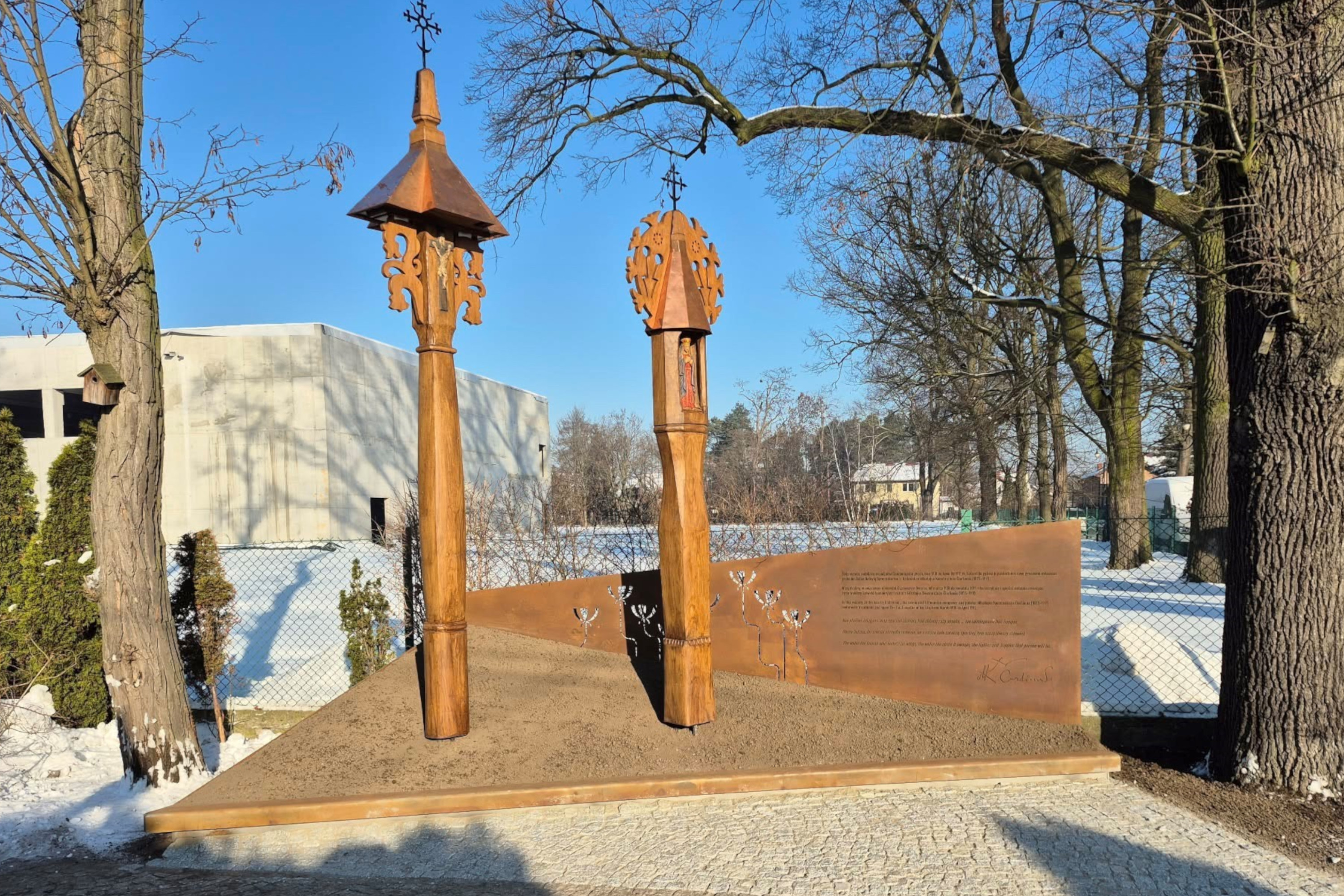
In Marki, near Warsaw, the memory of Lithuanian artist and composer Mikalojus Konstantinas Čiurlionis has been immortalized – on January 16, a wayside shrine and roofed shrine created by folk artist Antanas Vaškis from Žemaitija (Samogitia) were erected there, inspired by the artist's painting "Žemaičių koplytstulpiai". The artistic and sacred composition, erected near the former sanatorium-hospital where the artist spent his final years, was initiated and funded by the Department of Cultural Heritage (KPD).
It was here, in Markai (formerly Pustelnikas), at the former sanatorium-hospital, that M. K. Čiurlionis was treated from March 1910 to April 10, 1911.
Samogitian cross-crafting works – an idea of the KPD
"The idea to commemorate M. K. Čiurlionis in this way arose in the fall of 2022, when Lithuania began to consider how to mark the 150th anniversary of his birth. A delegation from the KPD, together with representatives of the Polish Ministry of Culture and Heritage, the Lithuanian Embassy in Poland, and the Markai local government, visited the sanatorium-hospital building where M. K. Čiurlionis spent his last days," said KPD director Vidmantas Bezaras. "Then, in the Marki municipality, we discussed the possibilities of inheriting and managing the building and installing rooms and artistic accents dedicated to the memory of the genius. However, the building now belongs to nuns. Its administrators (Zgromadzeniu Siostr Franciszkanek Rodziny Maryi) categorically refused to cooperate and would not discuss the restoration of the building or any memorial to the artist.
After this meeting, a proposal was made to erect memorial signs next to the entrance to the monastery as an alternative to the previous one. Unfortunately, KPD waited a long time for a response regarding this location, and it was repeatedly proposed elsewhere. The bureaucratic procedures dragged on until the end of 2025. New obstacles to its implementation in 2025 kept cropping up. However, we are glad that we succeeded. Things started moving after these issues were discussed at a meeting between the presidents of Lithuania and Poland in Vilnius and after discussions between Polish institutions and representatives of the Lithuanian embassy at the presidential residence in Warsaw.
Two years later, with the help of the Polish Ministry of Culture and Heritage, the building was entered into the local heritage register, making it possible to obtain Polish state funding. This saved the building from demolition, but the nuns refused to take advantage of the support.
Three years of bureaucratic obstacles
"Unable to commemorate the artist on the wall of a specific building, we looked for ways to do it elsewhere. I remember talking to my colleague Alfredas Jomantas, and we came up with the idea of commemorating him with wayside shrines, like the ones M. K. Čiurlionis painted in his 1909 painting "Žemaičių koplytstulpiai" (Samogitian Wayside Shrines)," said V. Bezaras. "While searching for a suitable woodworker, we chose Antanas Vaškys, a folk artist living in Žemaitija National Park, who has mastered the Samogitian style of cross-crafting, having studied under the famous cross-maker Stanislovas Riauba. I am very happy that he agreed." A. Vaškys carved the chapel from a single piece of wood.
In Koplytstulpis, A. Vaškys carved Mary of Sorrows from the same solid piece of wood. The metal crosses for these works were created by cross-maker Artūras Platakis.
The architectural solutions were implemented by Gediminas Antanas Sakalis' design firm. Architects G. A. Sakalis and Vaidotas Paliulionis thought through every detail so that the artistic composition would be perfectly visible from various street corners. KPD Chancellor Dainius Čergelis contributed greatly to the implementation of the entire project, its preparation, coordination with Polish institutions, and the transportation of the roof pillars, with the assistance of Lithuanian Cultural Attaché in Poland Ana Kočegarova-Maj. It took three years from the idea to its implementation, and the installation of the Samogitian cross-crafting works took place between the 150th anniversary of M. K. Čiurlionis' birth and the 115th anniversary of his death.
Samogitian heritage conservationists have determined that the wayside shrines depicted in M. K. Čiurlionis' painting "Samogitian Wayside Shrines" are from the Kuliai area. They stood in different places, and the artist "collected" them into one painting.
The text with a quote from M. K. Čiurlionis is inscribed on a one-tonne plate of Corten steel (a naturally rusting metal). Together with the oak elements, it forms a harmonious color whole. The concrete work for the entire structure was carefully carried out by cheerful local Lithuanians who came from Punsk.
Another reason to stop in Markos
The Department of Cultural Heritage invites everyone passing through Markos (the Warsaw bypass to Western Europe runs nearby) to stop by.
The Department of Cultural Heritage invites everyone traveling through Markus (the Warsaw bypass to Western Europe passes nearby) to stop at this location (ul. Kasztanowa 21). You will be greeted by a 3.6 m high Samogitian chapel pillar and a 4.5 m high roof pillar, as well as a memorial plaque with the words of the genius in three languages: "The wider a person's soul spreads its wings, the greater the circle it will fly... the happier that person will be."
This artistic and sacred composition also represents Lithuanian cross-crafting, which is included in the UNESCO list of intangible cultural heritage. "Cross-crafting works were always erected to commemorate significant places, events, or exceptional personalities. Therefore, these wayside crosses, is proof of our living tradition," said folk artist A. Vaškys.
Once winter is over and the project is finally completed, the KPD will invite everyone to the presentation of this artistic and sacred composition and to honor the artist in April of this year, when we will commemorate the 115th anniversary of M. K. Čiurlionis' death.
It should be emphasized that this entire project was implemented on the initiative and with the efforts of the employees of the Department of Cultural Heritage, without receiving any additional funding. Therefore, the heritage community can rejoice and take pride in yet another Lithuanian accent, expressing the nation's gratitude and respect for the artist and composer M. K. Čiurlionis, who has made our country famous.
Photo by Jurgis Ivoška