

A Book on the Way of St James in Lithuania and Its Pilgrims Has Been Published
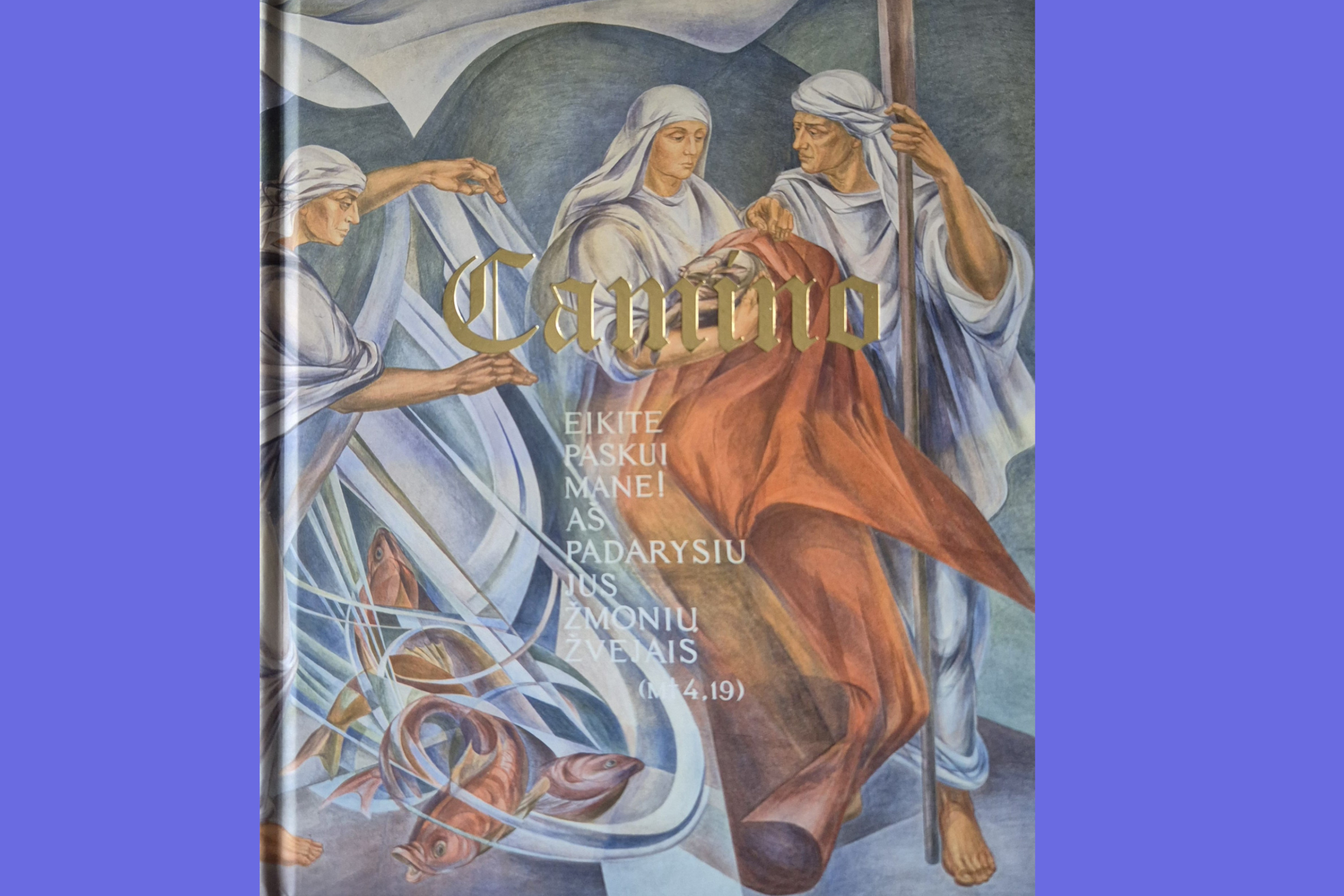
The book “CAMINO. The Way of St James in Lithuania and Its Pilgrims” (in Lithuanian and English, compiled by Laima Andrikienė) tells the story of the European network of the Way of St James, of which the Lithuanian routes have become a part. It presents the pilgrims who promote this path, and the activities of the Association of Friends of the Way of St James.
The publication of the book was partly financed by the Department of Cultural Heritage under the Ministry of Culture (KPD). The publishers – the Association of Friends of the Way of St James – are donating copies to all Lithuanian universities, public libraries, municipalities along the Way, as well as to gymnasiums of those municipalities and elderships. The book has already reached readers in Ukraine, Luxembourg, Taiwan, Spain, Germany, Slovenia, Belgium, and elsewhere. In early October, its compiler L. Andrikienė personally delivered and gifted copies to many Lithuanian municipalities, elderships, churches, and dioceses along the Way of St James. Many had also received the book earlier during a summer pilgrimage with participants from Taiwan and Ukraine.
The First Pilgrims from Lithuania
Historian Prof. Dr. Raimonda Ragauskienė, in her article “The Great Catholic Pilgrimages from Lithuania in the 15th–18th Centuries”, recounts the journeys of the first Lithuanian pilgrims – such as Grand Duchess Ona Vytautienė, who in 1400 traveled to the lands of the Teutonic Order in Prussia, combining her pilgrimage with diplomatic purposes. Another well-known pilgrimage was that of nobleman Mikalojus Kristupas Radvila Našlaitėlis to the Holy Land at the end of the 16th century.
The first Lithuanians to reach Santiago de Compostela and the shrine of St James were the Radziwiłł princes of Olyka and Nesvizh. In 1579, the future cardinal Jerzy Radziwiłł and his brother Stanisław Radziwiłł, Grand Marshal of the Grand Duchy of Lithuania, undertook a pilgrimage to Santiago.
On Pilgrimage and Its Meaning
The book cites Marcelino Oreja Aguirre, the distinguished Spaniard and father of the 1987 Santiago de Compostela Declaration of the Council of Europe, which proclaimed the Way of St James as the first and oldest European Cultural Route. At an international conference in Vilnius in 2013 he said:
"Today, just as in the past, all those who travel to Compostela return as if newly reborn, having discovered new horizons, having learned to live with others under the same conditions of the nameless pilgrim – inspired by the Way itself and its greatness – having discovered themselves. The mark left on Europe by these pilgrimages is so great that walking the Ways of St James is in itself a form of cultural study and practice. Today, it is recognized cultural heritage – both spiritual and material. That is why it is so important to turn our gaze toward the Way of St James in Europe – the Way of unity, into which many different paths from all over converge. The Way of St James is like an ancient, time-tested core of humanity, and everyone who walks it becomes its heir."
Dr. R. Ragauskienė also explains the meaning of holy places for Christians:
"Christianity has no single holy place that must be visited as a religious obligation. In the Western Christian world, by the early Middle Ages, four major pilgrimage destinations were established, known as the Great Pilgrimages by the Catholic Church: Jerusalem in the Holy Land, the spiritual capital of Christianity since the 4th century; Rome, with its sites recalling Jesus, the Apostles, and the beginnings of the Church; Santiago de Compostela, with the tomb of St James the Apostle; and Loreto, which by the late Middle Ages had become a universal pilgrimage center, marking the place where the angel announced to Mary the incarnation of the Son of God."
The Way of St James Through Lithuania’s Cultural Heritage
When asked how she was inspired to launch the initiative of establishing the Way of St James in Lithuania, Laima Andrikienė, its founder, replied:
"If someone had told mea dozen or so years ago – even when, at the bid and with the encouragement of my Spanish colleagues, I was travelling acrons Lithuania, visiting one St. James church after another, collecting material for my report to my fellow members of the European Parliament about the footprints of St James the Apostle in Lithuania – that, for thirteen years straight, I would be moving orward, withour giving up and giving in, covering one route after another in the company of a handful of my most trusted companions, paving ways for St James pilgrims of the future, I would never have believed it that something like that could happen to me.
(...). As you read the pages of this book, you will see the aims that drive us to create the St James routes in Lithuania. You will discover our rich cultural heritage and traditions, and appreciate the beauty of our regions, towns, villages, sanctuaries, architectural monuments, manors, and parks. In the maps, you will also find the international St James route, which intersects with the John Paul II Pilgrimage Route – an example of how networks of cultural and pilgrimage routes enrich each other."
The book also quotes Dr. Stefano Dominioni, Executive Secretary of the Enlarged Partial Agreement on Cultural Routes of the Council of Europe and Director of the European Institute of Cultural Routes. In his article “Council of Europe Cultural Routes and the Tradition of Pilgrimage”, he emphasizes:
"Since its beginnings, the Council of Europe has been aware of the importance of cultural heritage for achieving greater unity among Europeans. One of its most innovative initiatives was to launch in 1987 the Cultural Routes of the Council of Europe Programme, to enhance the richness and the diversity of European heritage”.
The presentation of the book is scheduled for November at the Palace of the Grand Dukes of Lithuania, part of the National Museum in Vilnius.