

European Heritage Days – Exploring Lithuania's National Minorities
It has become a tradition that among the events of European Heritage Days (EHD), there are always interesting opportunities to explore the cultural heritage of Lithuania's national minorities, as well as guided walks through notable cultural sites and locations.
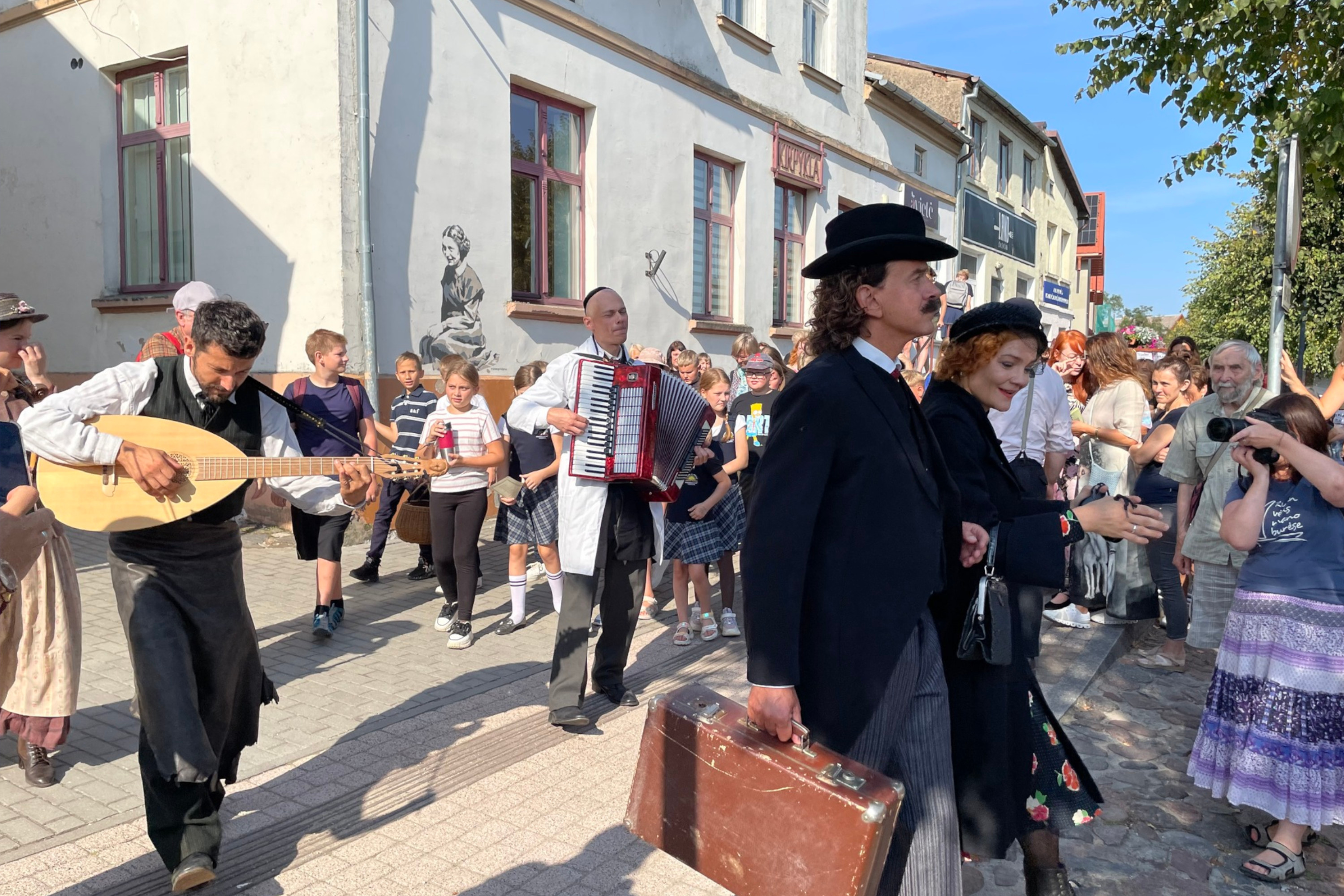
This year, the European Days of Jewish Culture coincided with the start of the EHD events, so it was a natural fit into the overall diversity of heritage links and routes. On this occasion, the afternoon event “The Joys and Rules of the Sabbath”, held at the Chaim Frenkel Villa-Museum in Šiauliai, introduced the participants to the symbols found in Judaism, their meaning, and discussed the allegories commonly found in religious art and their meaning. They also took part in the educational activity “Mizrah – Workshop of Paper Carvings” and visited the exhibition of Jewish carvings by Klaidas Navickas. In Švėkšna, the Šilutė Hugo Scheu Museum organized a theatrical event. The performance “Gekumen” (in Yiddish stands for “returned”) by the musical street theatre of the Old Arts Studio (Vilnius) emotionally and visually transported the spectator-participant to the life of Jews in Lithuania during the interwar period. Jewish traditional and interwar period stage music and real pre-war characters were used to recreate a forgotten period of Jewish culture.
This year, the participants of the EHD also got introduced to the culture of Lithuanian Old Believers - they took part in a trip to the Daniliškės Old Believer’s village in Trakai District, the participants visited the newly renovated St. Trinity Orthodox Church and learned about the cultural links between this religious community and Lithuania.
The Tatars are one of Lithuania’s largest ethnic minorities. EHD participants get introduced to the Tatar cultural heritage almost every year in Raižiai, Alytus District. This village is known as the Tatar capital of Lithuania. It still has a working mosque and one of the largest Tatar communities. This year’s EHD events included an exhibition “Tatars around us” and a guided walk “Two nations - one history”. After the events, the Tatars of Raižiai always treat their guests with a traditional cake – “šimtalapis” (“hundred-layer cake”), which has long been a part of Lithuanian cuisine.
Lithuanian Tatars have a long history: it is believed that the first Tatars began to settle in Lithuania in the 13th and 14th centuries, when the Grand Dukes of Lithuania, Gediminas, Algirdas and Kęstutis formed alliances with the Tatars to repel enemy attacks or to mount their own military campaigns. However, it was Grand Duke Vytautas of Lithuania (during his reign from 1392 to 1430) who attracted most of the Tatars to Lithuanian lands. The ruler invited Tatars as good and loyal soldiers to come to the Grand Duchy of Lithuania with their families, promising them lands and privileges. This Grand Duke of Lithuania is still important to the Tatars to this day, and his portrait can be seen in Tatar homes. This demonstrates the deep links between the Tatars and Lithuanian history.
During the reign of Vytautas Magnus (1392-1430), Tatar settlements appeared within the borders of present-day cities and districts of Vilnius, Trakai, Kaunas, and Alytus. Eventually, Lithuanian Tatars spread throughout Lithuania. Wherever Tatars lived, there was always a cemetery present. Many of the old Tatar cemeteries were particularly affected by the Soviet occupation, when all religion was forbidden, so there was no point in preserving the cemeteries of religious and national communities. Nevertheless, some of the old Tatar cemeteries were preserved in the village of Keturiasdešimt Totorių (in English stand for “forty Tatars”), Raižiai, Bazoriai, Pilkapiai, Padvariškės, Vinkšnupiai, in the surrounding villages of Adamoniai and Kerai, and in Nemėžis.
The Department of Cultural Heritage under the Ministry of Culture financed the marking of the destroyed sites of the old Lithuanian Tatar cemeteries. Under an agreement with the Union of Lithuanian Tatar Communities, commemorative markers with information about the old Tatar cemeteries will be installed at twelve former cemetery sites between 2021 and 2022. To ensure longevity, natural stone stelae with Tatar symbols have been erected and a memorial plaque has been unveiled on the outer wall of the former Lukiškės Prison, with information about the Tatar cemetery that has been destroyed on the site since the establishment of the Tatar community at the end of the fourteenth and the beginning of the fifteenth century.
The destroyed old Tatar cemeteries are marked in Kaunas (Mindaugas/S. Daukanto St.), as well as in Kaunas near the mosque, in Vilnius, on Lukiškių Street, in Vilnius District: on Pagirių Street, in the village of Melekoniai, in the village of Merešlėnai, in Liudvinava, in Kenai, in Medininkai, two cemeteries in the village of Keturiasdešimt Totorių, in the district of Alytus, in the Punia Eldership. A commemorative plaque has also been unveiled in Vilnius, on Lukiškių Street, on the site of the Lithuanian Tatar Cemetery, which was destroyed by decision of the Russian Tsarist authorities in 1901-1902 when a prison was built there. It also commemorates Olgierdas Naumanas Mirza Kričinskas, a prominent Lithuanian Tatar public figure and lawyer, who was imprisoned in this prison and later sent to Gorky Prison in Russia by the decision of the NKVD.
Tatars refer to cemeteries as mizar or ziretė. All the old Tatar cemeteries are characterized by the fact that the graves were not separated from each other, as is now the case. The Tatars did not enclose the graves with fences because they believed that after death all people are equal, regardless of their social status, wealth and other differences in earthly life. However, the cemetery itself was usually fenced with stones.
It is not only cemeteries that are marked. In Kaunas, a commemorative plaque marked a place - the suburb of Tatars - where Tatars have lived since the 15th century. Here, on the former road to Vilnius, a stone quadrangular tower of the Tatar Gate stood in the 17th-18th centuries. To learn more about Tatar culture, participants also visit the old Tatar cemetery in Lithuania.
Author: Jūratė Mičiulienė
Photo: Andrius Jakubaitis. In Švėkšna, the Šilutė Hugo Scheu Museum organized a theatrical event. The performance “Gekumen” (in Yiddish stands for “returned”) by the musical street theatre of the Old Arts Studio (Vilnius) emotionally and visually transported the spectator-participant to the life of Jews in Lithuania during the interwar period.