

Cultural heritage linking Lithuania and Ukraine
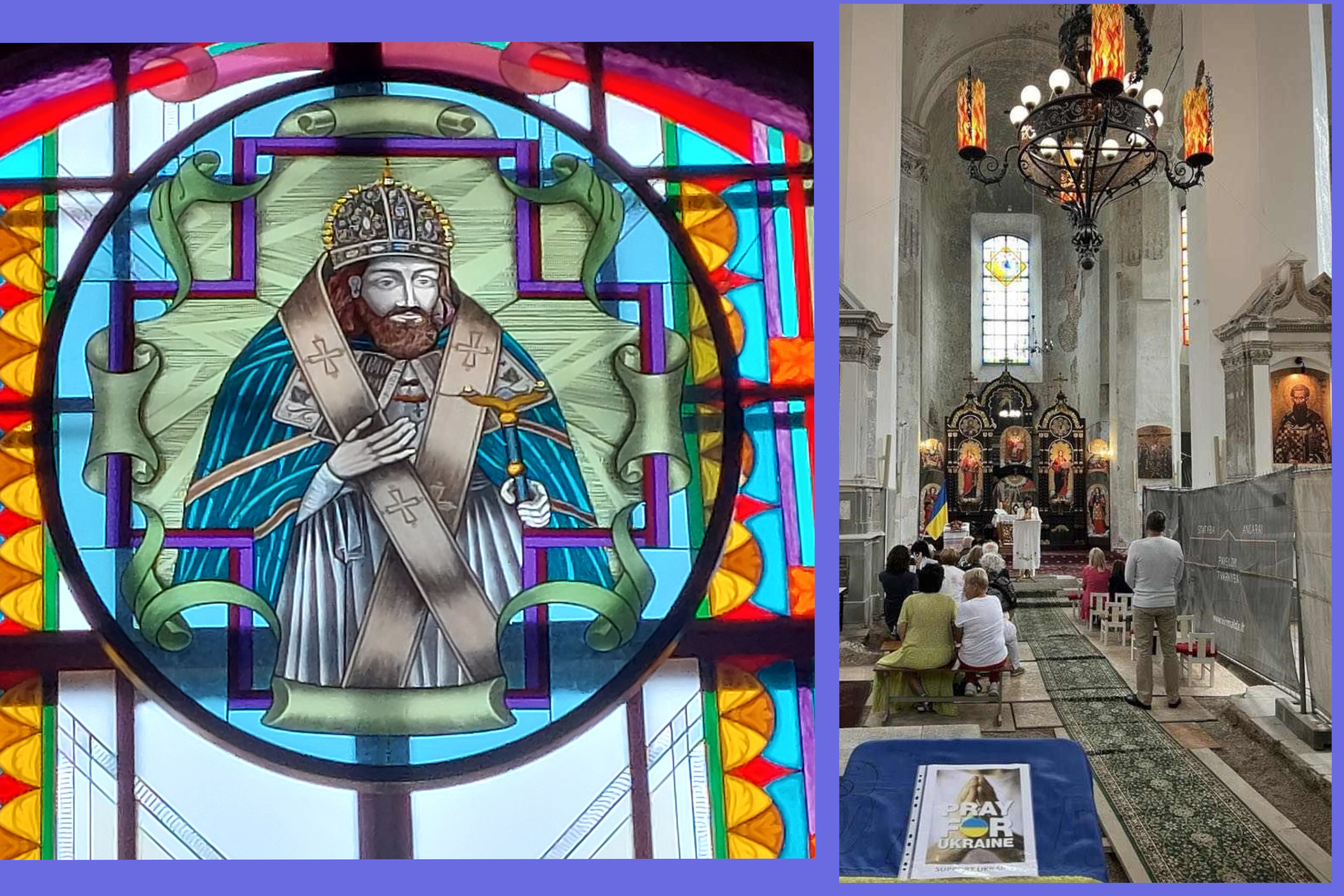
During the European Heritage Days in Lithuania, one of the most important events illustrating the historical links between Lithuania and Ukraine took place at the Vilnius Holy Trinity Greek Catholic (Uniate) Church. Genė Kirkienė, PhD, Associate Professor at the Faculty of History of Vilnius University, delivered a public lecture on the stained-glass project in this church, which tells an important story in the language of art not only for Lithuania and Vilnius, but also for the entire region - the former lands of the Grand Duchy of Lithuania (GDL), as well as for Europe - and highlights the rich and distinctive multicultural heritage of the GDL, the common heritage of Lithuania and Ukraine.
The stained glass depicts the Orthodox Christian martyrs of Vilnius, Saint Basil the Great, the Holy Trinity, Metropolitan Joseph Benjamin Rutsky of Kyiv, the coat of arms of the Basilian Order, the printing house of the Basilian Order, and a stained-glass window dedicated to the Union of Brest (1596). Also important is the stained-glass window dedicated to St. Josaphat Kuntsevych, whose 400th anniversary of martyrdom was commemorated last year in Lithuania. The lecturer also shared the latest research on Prince Konstiantyn Ostrozky (1460-1530), for whom a stained-glass window is also planned.
The Seimas of the Republic of Lithuania has declared 2023 year as the Year of Saint Josaphat. We celebrated the 400th anniversary of the martyrdom of this Greek Catholic (Uniate) saint, a link between Lithuania and Ukraine. St. Josaphat Kuntsevych (1580-1623) was born in Ukraine, but began his spiritual journey in Vilnius, where he spent twenty years and left a distinct imprint on our history. He devoted his life to the unity of the Christian Church, and through his activities he gave meaning to the loyalty of the Greek Catholic Church to Europe. He was a distinguished clergyman, dedicated to the consolidation of the Uniate Church and the unity of the Christian Church on the whole.
During the Great Schism of the Church in 1054, splitting into Roman Catholic and Eastern Orthodox, Josaphat Kuntsevych sought to unite Orthodoxy and Catholicism, Constantinople and Rome in the seventeenth century. He promoted the Union of Brest, the union of the Roman Catholic and Eastern Orthodox Churches, which was proclaimed in 1596. The Orthodox Christians of Lithuania and Poland recognized the primacy of the Pope of Rome, while the remaining Orthodox Christians of the East did not. Josaphat Kuntsevych was martyred in Vitebsk (present-day Belarus) by the Orthodox Christians of Vitebsk, who were hostile to the Union of Brest. He was declared a saint in 1867. His remains were hidden for a long time in the Uniate Cathedral of Polotsk (where he had become the Bishop of Polotsk) and in 1949 were transferred to St. Peter’s Basilica in Rome.
Vilnius is full of traces of this saint and historical figure: he was a monk of the Vilnius Holy Trinity Monastery and joined the Basilian Monastery in Vilnius. Another important thing is that Josaphat Kuntsevych, as an Archimandrite of the Basilian Monastery of the Holy Trinity, together with Metropolitan V. Rutsky, united the Basilian monasteries of Vilnius and several ones in present-day Belarus, reorganized the Basilian Order and founded the Order of St. Basil the Great - the Congregation of the Holy Trinity with its center in Vilnius.
St. Josaphat is one of the most important contributors to the creation and establishment of Greek Catholicism not only in Lithuania, but also in the entire territory of the Polish-Lithuanian Commonwealth at that time. The activities, life and posthumous journey of St. Josaphat are particularly significant in the current context of the Russian war in Ukraine. St. Josaphat belonged to the Greek Catholics, whose rituals are slightly different from those of the Roman Catholics, but who also recognize the Pope of the Rome. As we know from history, Moscow has always sought to dominate in the field of religion. However, during the current war in Ukraine, the Ukrainian Orthodox broke away from Moscow and became subordinate to the Church of Constantinople. Therefore, these events are linked to the activities of St. Josaphat.
On the occasion of the 400th anniversary of the martyrdom of Saint Josaphat, the Department of Cultural Heritage under the Ministry of Culture, together with its partners - the Faculty of History of Vilnius University, the Faculty of Humanities of the Catholic University of Ukraine, and the Kyiv Christianity Research Program has organized an international scientific conference “Josaphat Kuntsevych: History, Legacy, Memory”. The public learned more about this personality, whose activities were undiscovered by many, and during the Soviet period were intentionally suppressed (the personality who promoted the Unification of Churches was not liked by Moscow). The Vilnius University Library hosted an exhibition dedicated to St. Josaphat, where the monastic and liturgical vestments of St. Josaphat were exhibited and displayed.
In the course of history, Muscovites, and later, the Russian and Soviet empires, have repeatedly attempted to destroy St. Josaphat’s Church, which is linked to Uniate heritage. The Holy Trinity Church in Vilnius, which was founded in 1514 by the famous military leader Konstiantyn Ostrozky after his important victory at the Battle of Orsha, where the army of the Grand Duchy of Lithuania defeated the army of the Grand Duchy of Moscow. In the 16th century, the church was handed over to the Basilian Uniates. After the partition of the Polish-Lithuanian Commonwealth, when Lithuania fell to Tsarist Russia, the church of the Basilian Unites was closed and an Orthodox Christian seminary was established. After Lithuania’s independence was announced in 1991, the church was handed over to the Greek Catholic (Uniate) community. In 1994, it was transferred to the Basilian Order of St. Josaphat in Lithuania.
The church was also damaged during Soviet times, when it housed the technological research laboratory of the Vilnius Engineering Construction Institute, and the church floor was completely destroyed. The church has been undergoing restoration for the last few years, and recently the old church floor has been restored.
Author: Jūratė Mičiulienė
Photos taken by Natalija Šervytienė and Diana Varnaitė